Nonviolent Communication for couples: NVC in your relationship
The 4 steps of NVC, real relationship examples, and how 4couple helps paired partners talk without fighting.
- 14 min read
- Communication
- Conflict

Written by 4couple Editorial Team
Published

Most couple fights are not about the dishes
It is 11pm. The dishes are still in the sink. One of you mentioned it an hour ago, and now the two of you are scrolling at opposite ends of the sofa, a couple in the same room and not talking.
Replay the argument and something strange appears: nobody in this relationship was fighting about plates. One partner was saying "I feel like I carry this home alone." The other partner heard "you are lazy and you are failing me." Neither sentence was spoken out loud, and both of them ran the whole conversation.
This is the gap that Nonviolent Communication (NVC) was built to close. It is a way of speaking and listening, developed by the psychologist Marshall Rosenberg, that turns "you never help" into something your partner can actually hear. Couples who learn it do not stop disagreeing. They stop wounding each other while they disagree, and that is what keeps a relationship warm through the ordinary friction of living as a pair.
In this guide you get three things: the basics of NVC in plain language, how we built NVC into 4couple so that neither partner has to remember the method in the heat of the moment, and a set of relationship communication scripts you can start using as a couple tonight.
Key takeaways
- The four components of NVC are observation, feeling, need and request.
- Blame is an unmet need said badly. Naming the need turns "you versus me" into "us versus the problem".
- NVC works even if only one partner starts: a new first sentence changes the reply.
- 4couple builds NVC into every message, so you never have to remember the method at 11pm.
What is Nonviolent Communication?
Nonviolent Communication (NVC), also called Compassionate Communication, is a communication method created by American psychologist Marshall Rosenberg in the 1960s and described in his book Nonviolent Communication: A Language of Life. Its starting idea is simple: behind every angry, critical or sarcastic thing a person says to their partner, there is an unmet need. Blame is a tragic way of expressing that need, because it almost guarantees the need will not be met.
NVC replaces blame with a four-part structure. The four components of NVC are observation, feeling, need and request. For couples, these four steps are the difference between a conversation that brings a pair closer and one that pushes them apart.
1. Observation
what happened, without judgment
Say what a camera would have recorded. "You never help around the house" is a judgment. "The dishes from dinner are still in the sink and it is 11pm" is an observation. The difference matters in a relationship because a judgment triggers defence, and a defensive partner cannot listen.
Instead of
You never help around the house.
Try
The dishes from dinner are still in the sink and it is 11pm.
2. Feeling
what is going on inside you
Name the emotion, not the accusation dressed up as one. "I feel ignored" is actually a verdict on your partner's behaviour. "I feel lonely" or "I feel exhausted" is a feeling. Real feelings are things like sad, scared, hurt, tired, frustrated, hopeful, relieved.
Instead of
I feel ignored.
Try
I feel lonely.
3. Need
the universal thing underneath
Every feeling points to a need. Loneliness points to connection. Exhaustion points to rest or support. Resentment usually points to fairness or being seen. Rosenberg's key insight is that needs are universal: your partner has the same need for respect, rest and appreciation that you do. Naming the need turns "you versus me" into "us versus the problem," which is the only configuration in which a couple can actually solve anything.
4. Request
a clear, doable, positive ask
Ask for a specific action, in the present or near future, phrased as what you want rather than what you want to stop. "Could you take the dishes tonight so I can sit down?" is a request. "Stop being so lazy" is a demand wearing a request's clothes. A real request accepts that your partner might say no, and keeps the relationship conversation open if they do.
Instead of
Stop being so lazy.
Try
Could you take the dishes tonight so I can sit down?
Put together, a full NVC sentence between partners sounds like this:
A full NVC sentence
"When the dishes are still in the sink at 11pm (observation), I feel exhausted and a bit alone (feeling), because I need to feel like we run this home together (need). Would you be up for taking the dishes on weeknights? (request)"
Jackal and giraffe

Rosenberg used two animals to make the method memorable. Jackal language is the default: judging, comparing, blaming, demanding. Giraffe language is NVC: the giraffe has the largest heart of any land animal and a long neck that lets it see far, so it speaks from the heart with perspective. Most of us speak jackal to our partner when we are tired or hurt. NVC is the practice of noticing the jackal and choosing the giraffe.
NVC is also a way of listening
The four components work in reverse too. When your partner says "you are always on your phone," NVC listening means hearing the observation (phone in hand), guessing the feeling (lonely, unimportant) and the need (attention, presence), and reflecting it back:
Empathic listening
"Are you feeling a bit left out, and wanting more time where it is just the two of us?"
This is empathic listening, and it is often the single most de-escalating thing one half of a couple can do.
Why couples need NVC more than anyone
Rosenberg described four habits that block compassion. In a relationship, all four can show up in a single evening.
01
Moralistic judgment
"You are so selfish." "A normal person would have called."
What it does to your partner: Puts them on trial. They defend or counter-attack instead of listening.
02
Comparison
"Anna's husband cooks every night."
What it does to your partner: Tells them they are losing a contest they never agreed to enter.
03
Denial of responsibility
"You made me shout." "I had to say it."
What it does to your partner: Hands them the blame for your feelings, so nothing in the relationship can change.
04
Demands
"You will be home by seven or we are done."
What it does to your partner: Leaves only two options: submit or rebel. Neither feels like love.
NVC fits couples so well because romantic partners are the people we are most honest with and least careful with. We would never tell a colleague "you never listen," but we say it to the person we share a bed with before breakfast. Familiarity makes a pair skip the observation, skip the feeling, skip the need, and go straight to the verdict.
There is a second reason. Couples argue about the same handful of relationship topics on repeat: money, chores, time together, intimacy, family, phones. When the topic is recurring, the words become a script, and scripts escalate faster each time because both partners already know their lines. NVC breaks the script by forcing a new first sentence. You cannot say "when the dishes are in the sink at 11pm, I feel exhausted" in a sneer. The structure itself slows the fight down.

And a third, which is the one we built 4couple around: the hardest moment to use NVC is exactly the moment a couple needs it. When you are flooded with anger or hurt, the part of your brain that calmly separates an observation from a judgment is offline. Everyone can do NVC on a worksheet. Almost no partner can do it at 11pm with a sink full of dishes and the other half of the pair sighing at them.
How 4couple builds NVC into your relationship
4couple is an AI relationship app for couples that uses Nonviolent Communication to help partners say what they mean. Once the two of you are paired in the app, NVC becomes the grammar every message between you is written in. Neither partner has to learn the four steps or remember the word "observation" while upset. You type what you actually feel, in whatever words come out, and the app does the NVC work with you. Here is how that looks across the features of the couples app.
Translate My Emotions
Your angry text, before you send it
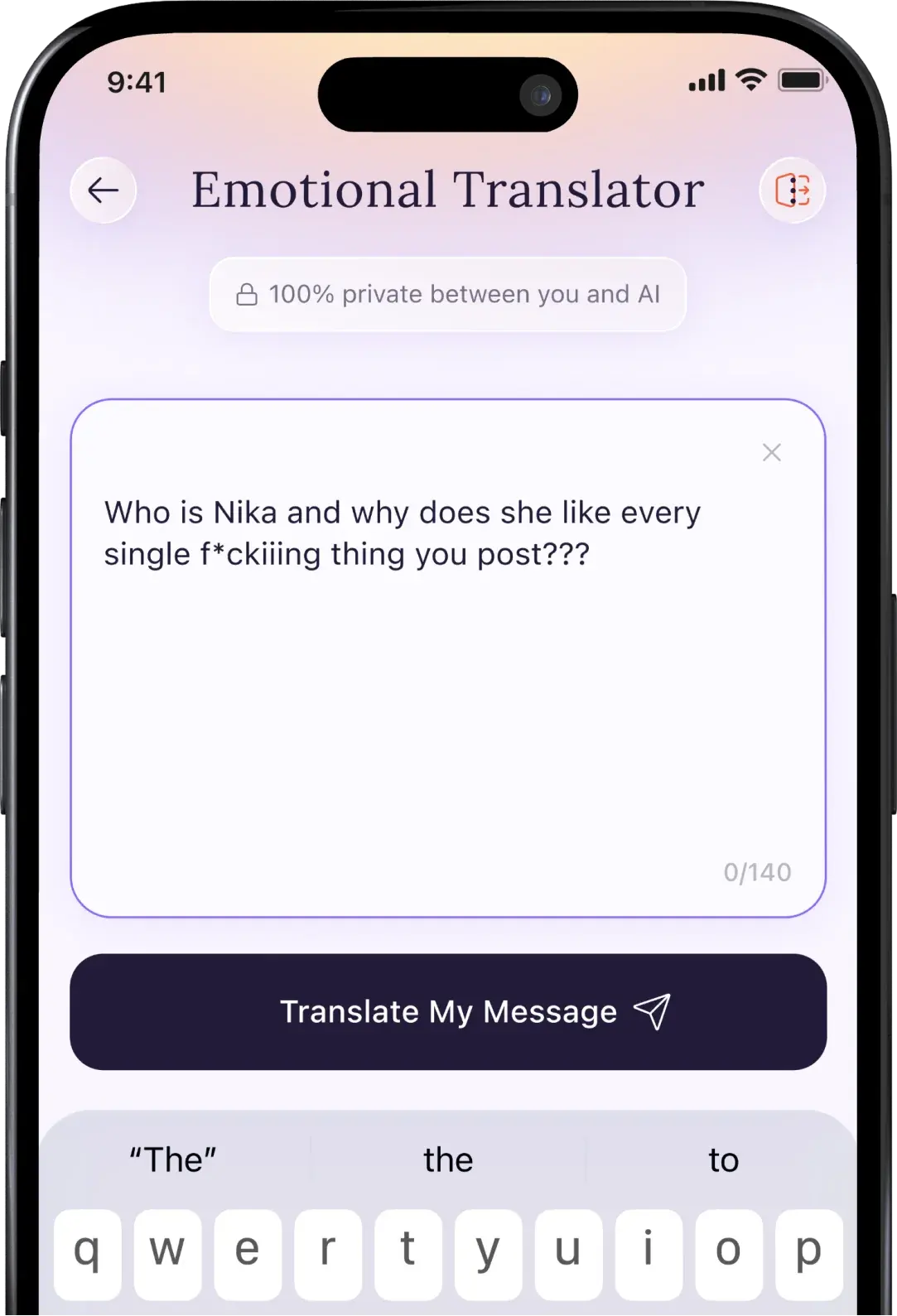
This is the relationship communication feature most people meet first. You open your private AI Companion, paste or type the message you were about to send your partner ("who is Nika and why does she like every single thing you post"), and the Companion reads it the way an NVC coach would. It looks for the four components. If the observation is missing, it asks one short question: "What happened right before you wanted to send this?" If the feeling is hiding under an accusation, it names what it hears: "It sounds like you are feeling left out, not suspicious."
Then it hands you a version in your own voice, two to four sentences, with the observation, the feeling, the need and a request all present and the insults gone:
What you typed
who is Nika and why does she like every single thing you post
What your partner gets
"I miss being the person you talk to most. Can we find a time this week that's just ours?"
You can copy it, edit it, ask for it softer or shorter, or start over. The Companion never sends anything to your partner for you, and it will not keep polishing a message you do not want to send. If it notices you are venting rather than asking, it says so and offers to just listen instead.
Partner Chat
A shared conversation where every opening message is NVC-ready
When you want to raise something with your paired partner inside the app, you start a Partner Chat. You write your first message raw, the same Translate My Emotions pipeline shapes it, and you approve it before it crosses to the other side of the couple. Your partner sees a short neutral topic card ("Roman wants to talk about how the evenings have been going") and then your words, in first person, at your best.
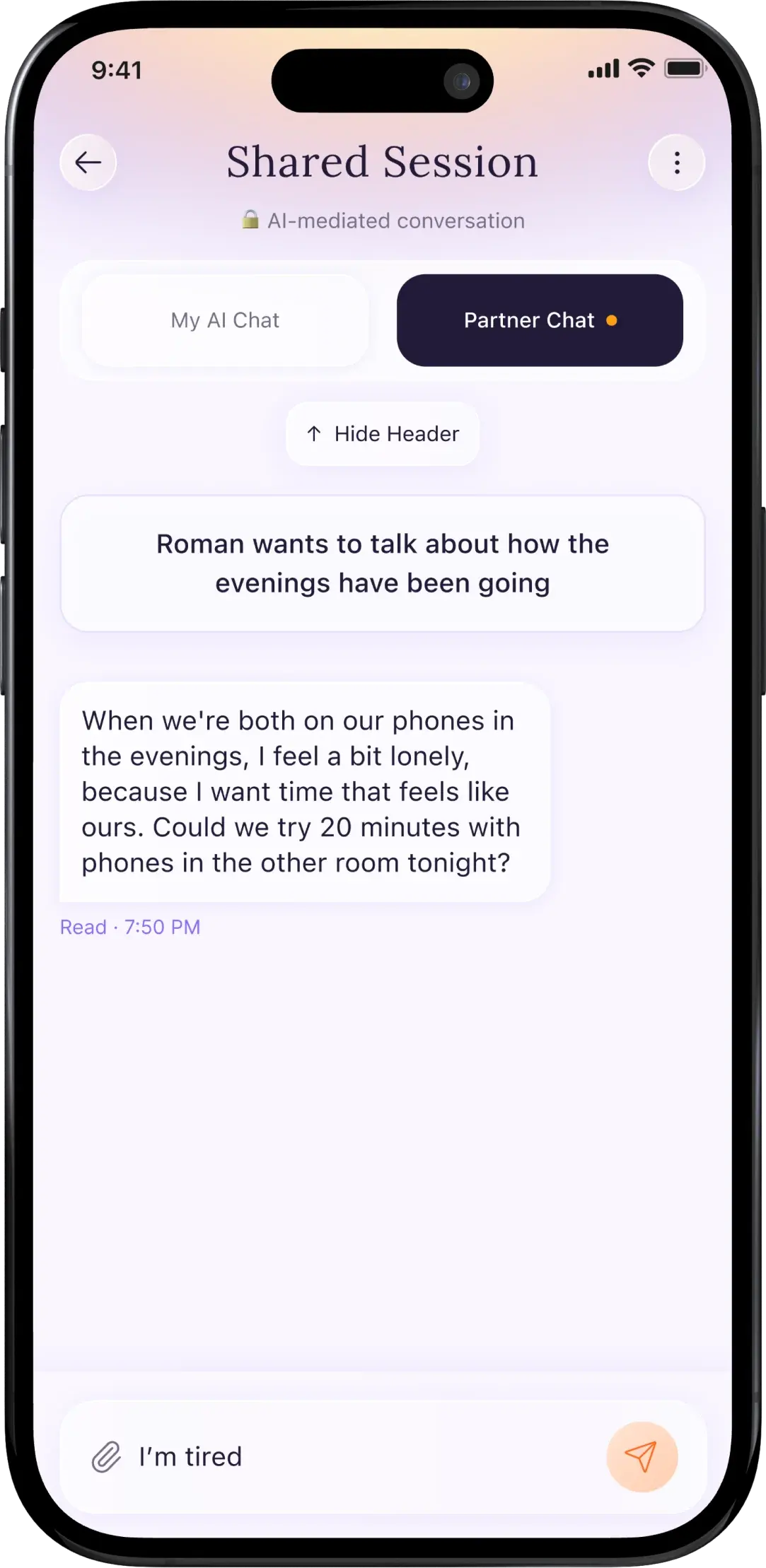
Their reply goes through the same door. If what they type is heated but has substance, the Companion helps them find the observation underneath. If they are too flooded to answer, it offers to talk it through privately first, and you simply see "your partner is working on their reply." Nothing from either partner's private conversation ever appears on the shared side of the relationship.
Once both of you have said your piece, the chat is yours and the pair of you talk directly. Two NVC safety nets stay one tap away:

Shape with AI
On your side. Runs your draft through the four steps before you hit send.

Discuss this message
On the receiving side. Take a message that stung into your own Companion before you fire back. It works out the feeling and the need behind your partner's words so you can respond to those, not to the tone.
"Let's talk about"
Guided NVC conversations on the hard relationship topics
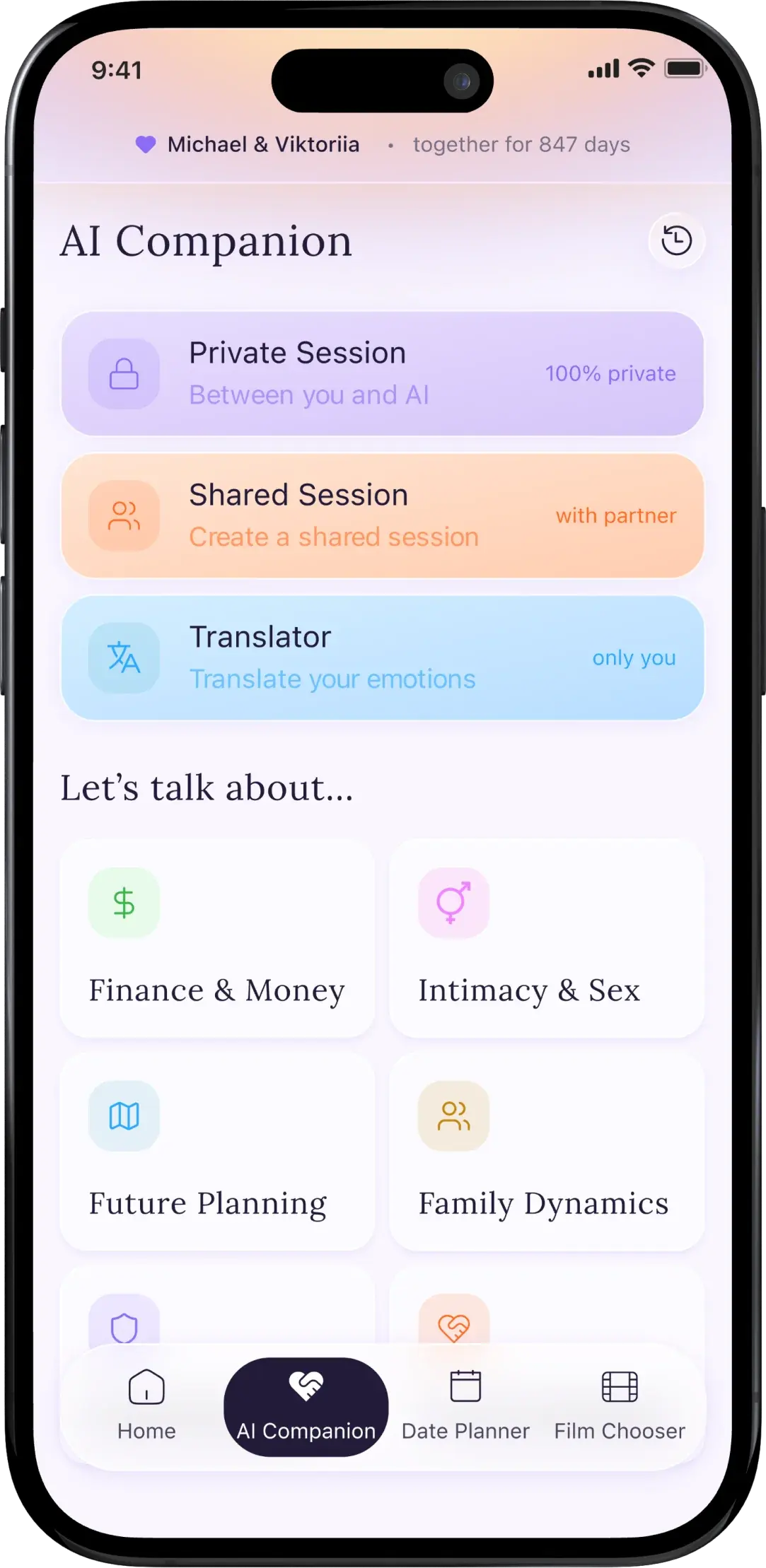
Some subjects are so loaded that neither partner wants to go first. 4couple ships guided couple conversations on the recurring ones. Each one opens with the same question for both partners, written so the answer is naturally an observation and a feeling rather than a verdict. You both answer, you both read, and the relationship conversation starts from needs instead of blame.
Money
Intimacy
Family & in-laws
Chores
Trust & jealousy
Future plans
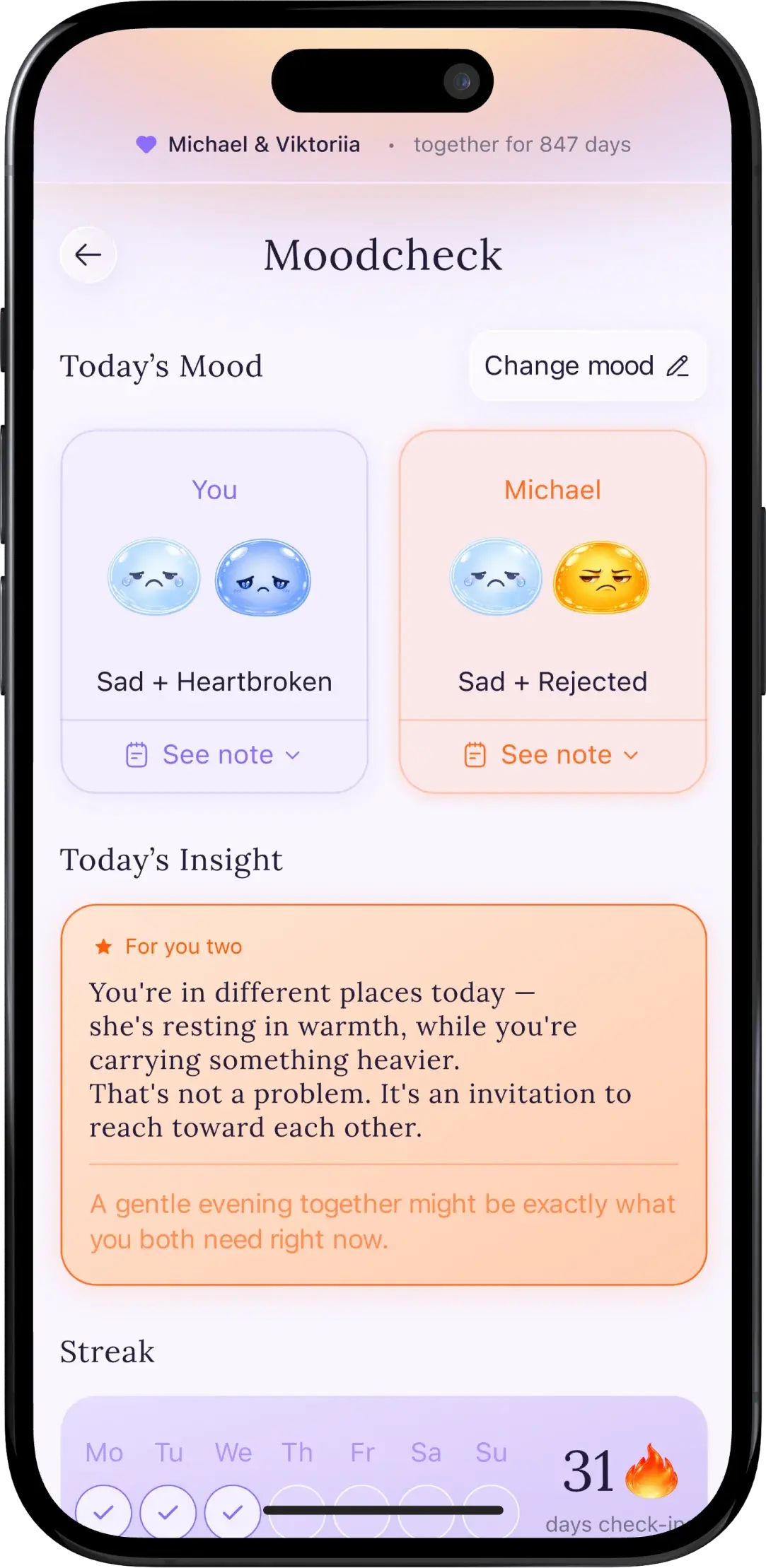
Daily mood check-in
The observation step, every day
The daily mood check-in for couples on your home screen looks like a wellness readout, but it is quietly the first NVC component in practice. Naming "I am at a 4 today, mostly tired" before anything has gone wrong is far easier than naming it mid-argument. Over time it gives a paired couple a shared, judgment-free vocabulary for how each partner is doing, which is exactly the vocabulary NVC asks for.
What we deliberately do not do

We do not lecture. The word "NVC" never appears in the app.
We do not score your messages or tell
a couple they are communicating badly.
We do not send anything on your behalf: every message that reaches your partner was approved by you, word for word.
The goal is not a relationship app that talks for you. It is a couples app that helps you say what you meant, the easy way.
How to use NVC with your partner in daily life
You do not need an app to start. Here is the method stripped down to what works for a couple in a kitchen at 11pm.
Not sure where your communication stands right now? Our free relationship quiz shows in two minutes where you feel close and where distance creeps in.
The one-sentence version
When you feel the jackal coming, buy yourself one breath and fill in this template, out loud or in your head:
The template
"When ___ (what happened), I feel ___ (one emotion), because I need ___ (one need). Would you be willing to ___ (one specific thing)?"
Observation
Feeling
Need
Request
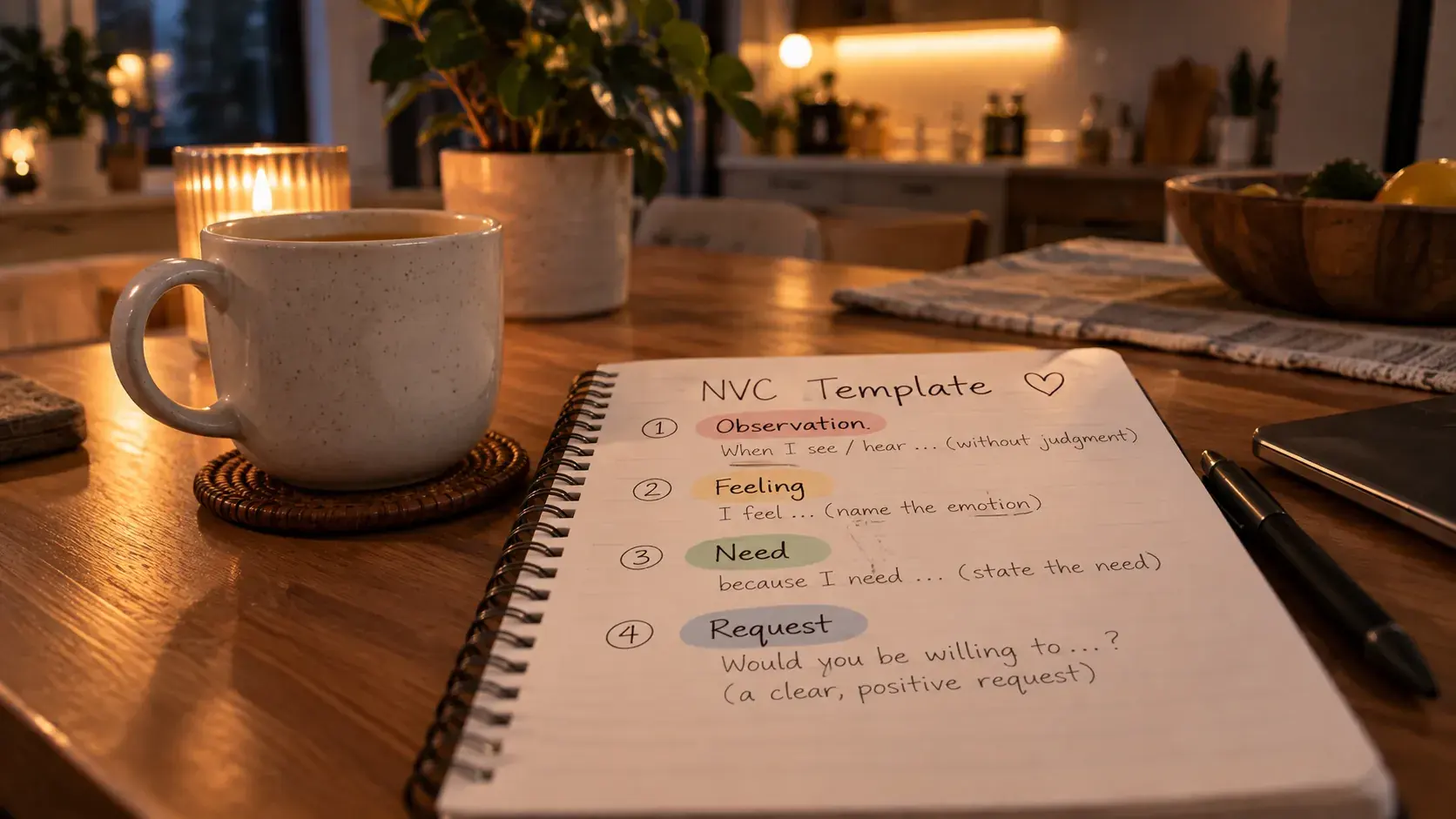
It will feel stiff the first ten times. That stiffness is the point: it is the sound of you not saying the thing you would have said to your partner.
Before and after: five couple fights, rewritten
What you were about to say
"You are always on your phone."
The NVC version
"When we are on the sofa and you are scrolling, I feel lonely, because I want time that feels like ours. Can we do 20 minutes with phones in the other room tonight?"
What you were about to say
"You never plan anything."
The NVC version
"I have booked the last four dates. I feel a bit invisible and I need to know you want this too. Would you plan next Saturday, anything at all?"
What you were about to say
"Your mother is impossible."
The NVC version
"When your mum commented on the flat on Sunday, I felt small and I needed you to have my back. Next time, could you say something in the moment, even one sentence?"
What you were about to say
"Fine. Whatever. Do what you want."
The NVC version
"I am too tired to do this well right now. I need an hour. Can we come back to it at nine?"
What you were about to say
"We never have sex anymore."
The NVC version
"It has been three weeks since we were close. I miss you and I feel unsure where I stand. Can we talk about what has been getting in the way?"
Notice the fourth one. A boundary is a valid NVC message. "I need an hour" has an observation, a feeling, a need and a request. NVC is not about forcing a relationship conversation. It is about not detonating it.
A feelings and needs cheat sheet for couples
Most people have five words for feelings and all of them are "fine." Keep these somewhere both partners can see them.
Feelings when needs are not met
hurt
lonely
scared
anxious
exhausted
frustrated
disappointed
embarrassed
overwhelmed
resentful
numb
unsure
Feelings when needs are met
relieved
calm
warm
grateful
hopeful
close
safe
playful
proud
excited
Needs that drive most couple conflict
connection
appreciation
rest
fairness
autonomy
trust
being seen
support
play
intimacy
security
respect
The four mistakes every couple makes at first
1
Fake feelings.
"I feel ignored", "I feel abandoned", "I feel like you don't care" are judgments about your partner wearing a feeling costume. The test: can you put "by you" after it? Then it is a judgment. Try "lonely" or "scared" instead.
2
Observations with a verdict inside.
"When you ignore me" is not an observation. "When I asked twice and got no answer" is.
3
Requests that are demands.
If a "no" would cause a punishment, it was a demand. Ask, then accept the no and ask your partner what they could do instead.
4
Doing NVC at your partner.
The method is not a trick to win. If you use the four steps to prove you are the reasonable half of the couple, your partner will feel it. Lead with listening: guess their feeling and need before you state yours.
A seven-day start for a pair
Day 1–2
Only observe
Once a day, catch a judgment in your head ("he is being lazy") and rewrite it as a camera would see it ("he has been on the sofa since six"). Say nothing yet.
Day 3–4
Add feelings
Tell your partner one real feeling a day, unrelated to any conflict: "I felt really calm on the walk today."
Day 5
Needs
Next time something small bothers you, find the need before you speak. Do not speak until you have it.
Day 6
One full request
Make one full request using the template. Pick something small and winnable.
Day 7
Listen
When your partner complains about anything, reply only with a guess at their feeling and need. "Sounds like you are wiped out and just want some quiet?" Watch what happens between the two of you.
If you want a shortcut for the hard moments, this is what 4couple's Translate My Emotions does for a couple in about ten seconds: you type the jackal, it hands you the giraffe, and you decide whether to send it to your partner.
FAQ about NVC for couples
What is Nonviolent Communication in simple terms?
Nonviolent Communication (NVC) is a way of talking and listening, created by Marshall Rosenberg, that focuses on what you observed, what you feel, what you need, and what you are asking for, instead of on blame and judgment. For couples it is a method for raising relationship problems without starting a fight.
What are the four components of NVC?
The four components of NVC are observation, feeling, need and request. You state what happened without judgment, name your emotion, name the need behind it, and make a specific, doable request of your partner.
Is NVC the same as "I statements"?
I statements ("I feel X when you do Y") are one piece of NVC. NVC adds the need behind the feeling and a clear request, and it includes empathic listening, which I statements leave out.
Does NVC mean I can never be angry with my partner?
No. Anger is welcome in NVC; it is treated as a signal that an important need is unmet. What NVC removes is the blame, not the feeling. "I am furious and I need to feel respected" is a perfectly good NVC sentence.
Does NVC work if only one partner in the couple uses it?
Yes, and usually one partner starts. Because NVC changes the first sentence of an argument, it changes the reply too. Over time, partners tend to mirror the relationship language they are receiving.
How does 4couple use Nonviolent Communication?
4couple is an AI relationship app for couples that uses Nonviolent Communication to help partners say what they mean. Its Translate My Emotions feature turns a raw, angry draft into an observation-feeling-need-request message in your own voice, Partner Chat shapes both paired partners' opening messages the same way, and the "Let's talk about" guided conversations open the hard relationship topics with NVC-style questions. You never see the method; you only see better messages.
Is 4couple a relationship coach app?
4couple includes an AI Companion that works like a relationship coach for everyday communication: it helps each partner understand what they feel and say it well. It is a communication tool, not a clinical service, and not a replacement for professional help. If you are in a relationship that feels unsafe, please reach out to a qualified professional or a local support line.
Where can I learn more about NVC?
Marshall Rosenberg's book Nonviolent Communication: A Language of Life is the primary source, and the Center for Nonviolent Communication (cnvc.org) offers free feelings and needs lists and trainer directories.
Sources & further reading
- Rosenberg, M. B. Nonviolent Communication: A Language of Life.
- Center for Nonviolent Communication — cnvc.org (feelings & needs lists, trainer directory).
4couple is a communication tool, not a clinical service, and not a replacement for professional help. If you are in a relationship that feels unsafe, please reach out to a qualified professional or a local support line.