How love languages, attachment styles and closeness types fit together
Three layers that explain how you love, plus the real six-statement test from the 4couple app to find your Connection Type.
- 16 min read
- Relationships
- Couples quiz

Written by 4couple Editorial Team
Published
The same fight, three different causes
She says: "You never tell me you love me." He says: "I fixed your bike, I cooked dinner, I booked the trip. What else do you want?" Both of them are right, and the couple still feels off.
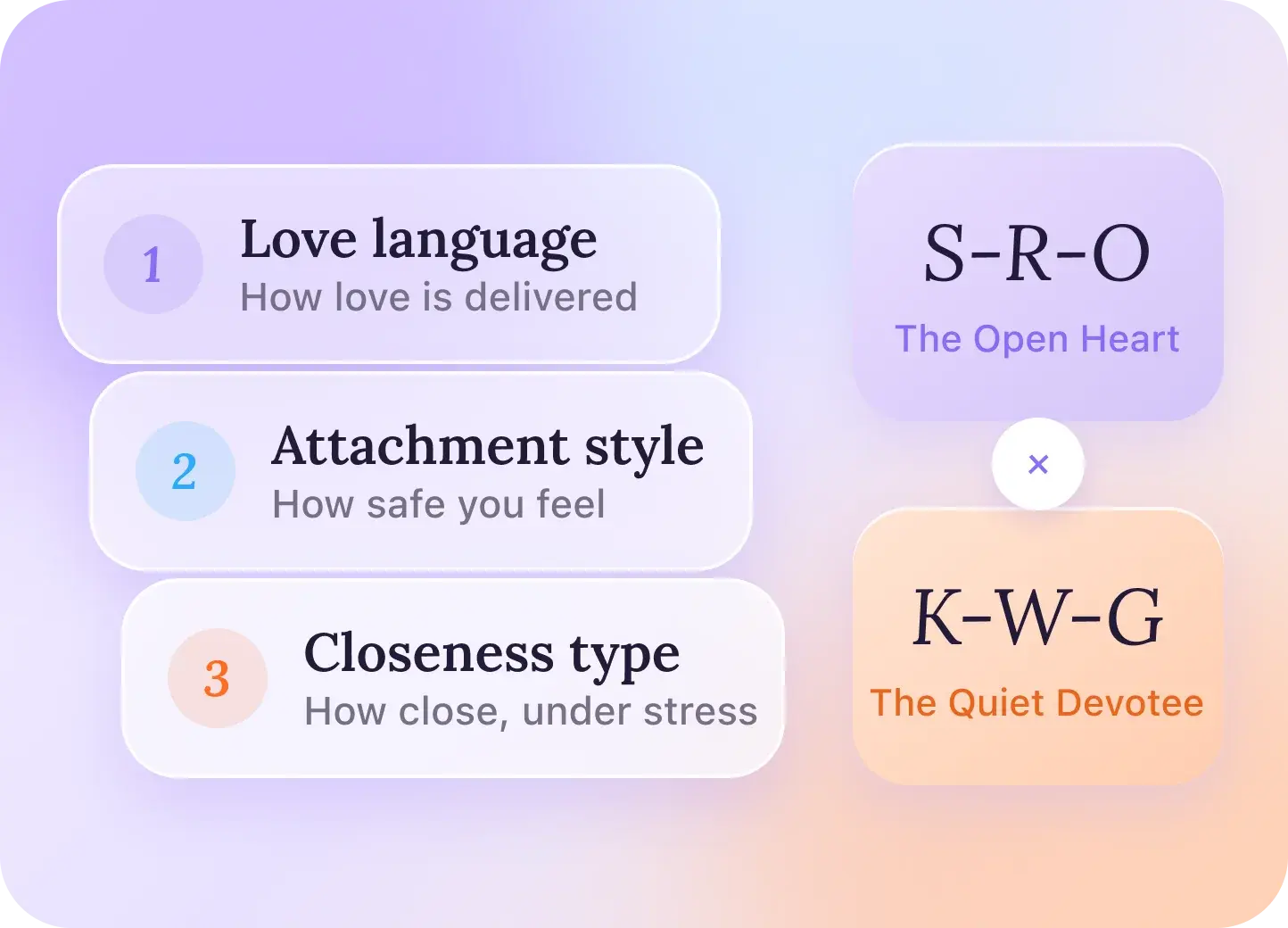
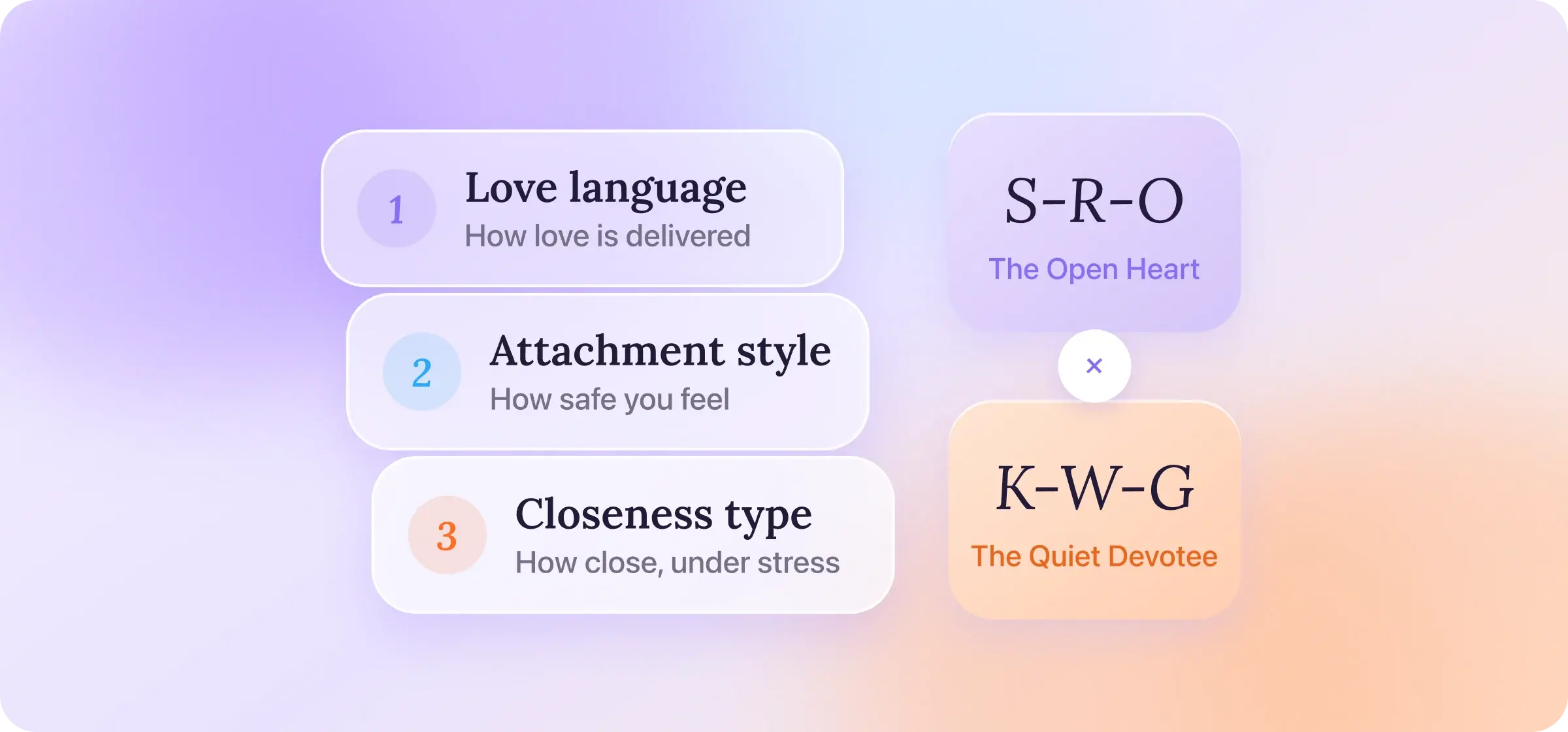
The love-languages answer is that she hears love in words and he speaks it in acts of service. True, and not enough. Look again and there is a second layer: when she feels distance she reaches for him, and when he feels pressure he goes quiet, so every small gap turns into a chase. That is attachment. And a third: she sorts out her feelings by talking, he sorts them out alone in the garage, so even when both want closeness they go looking for it in different rooms. That is closeness type.
1
Layer 1
Love language
How love is delivered
2
Layer 2
Attachment style
How safe each partner feels
3
Layer 3
Closeness type
How close you want to be under stress
Most couples quizzes stop at the first layer. A love language test tells a couple how they like to receive love. It does not tell them why one partner panics when the other needs space, or why "let's talk about it now" lands as an attack on one person and as relief on the other. For that you need all three layers together, which is what we call a Relationship Profile.
This post explains the three layers in plain language, lets you take the real six-statement test from the 4couple app and find your Connection Type (The Open Heart, The Steady Anchor, The Wholehearted and five more), and shows what happens when two profiles meet in one paired couple.
Key takeaways
- The three layers of a Relationship Profile are love language, attachment style and closeness type.
- Love language explains how love is delivered; attachment and closeness explain how safe and how close each partner wants to feel.
- Six statements place you in one of eight Connection Types, from The Open Heart to The Quiet Devotee.
- The real insight is the couple combination: how your two profiles meet, and the one move that helps most.
Layer 1: what are the five love languages?
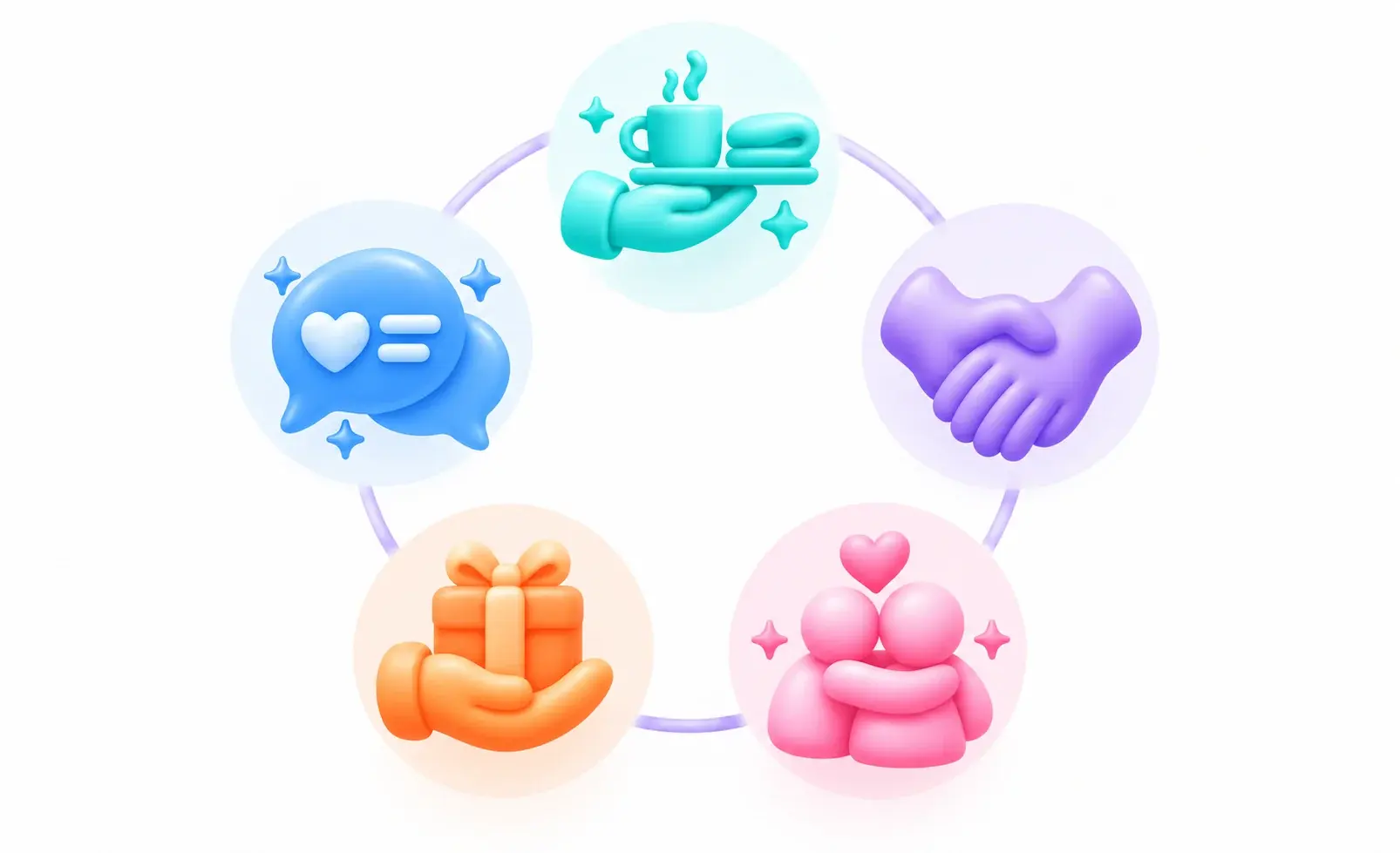
The five love languages are words of affirmation, quality time, acts of service, receiving gifts and physical touch. The idea comes from Gary Chapman's 1992 book The 5 Love Languages: each person has one or two primary ways of giving and receiving love, and couples drift apart when each partner keeps speaking their own language instead of the other's.

Words of affirmation
Feels loved
Hearing it: "I'm proud of you", "I missed you"
Gives
Compliments, notes, saying it out loud

Quality time
Feels loved
Undivided attention, phones away
Gives
Planning time together

Acts of service
Feels loved
Things done for them without being asked
Gives
Fixing, cooking, handling the admin
Receiving gifts
Feels loved
A thoughtful object that says "I was thinking of you"
Gives
Small presents, souvenirs

Physical touch
Feels loved
Hand-holding, hugs, closeness on the sofa
Gives
Reaching for their partner
What the love language explains: the daily currency of a relationship, and why one partner can feel starved while the other feels they are giving everything. In 4couple, the love language is the very first thing each paired partner picks during onboarding, because it tells the AI Companion which language to coach you in when you talk to your partner.
What it does not explain: why the same couple handles conflict so differently, or why one partner needs reassurance and the other needs room. The love language is about how love is delivered. The next two layers are about how safe each partner feels, and how close they want to be.
Layer 2: what are attachment styles in a relationship?
Attachment style is the pattern you fall into when you feel close to someone and when you feel they might pull away. The science comes from John Bowlby's attachment theory and Mary Ainsworth's studies of infants in the 1960s and 70s; Cindy Hazan and Phillip Shaver showed in 1987 that the same patterns appear in adult romantic relationships. Four styles are commonly described.
Secure
Inside the person
Comfortable with closeness and with space; trusts the bond will hold
What the partner sees: Steady, easy to reassure, does not keep score
Anxious (preoccupied)
Inside the person
Needs reassurance; reads silence as a threat; moves closer when worried
What the partner sees: Texts twice, asks "are we OK?", feels hurt by small distance
Avoidant (dismissive)
Inside the person
Values independence; feels crowded by too much closeness; moves away when stressed
What the partner sees: Goes quiet, changes subject, "I'm fine"
Disorganized (fearful)
Inside the person
Wants closeness and fears it at the same time; can swing between the two
What the partner sees: Pulls in, then pushes away, hard to predict
The pursuer-withdrawer loop
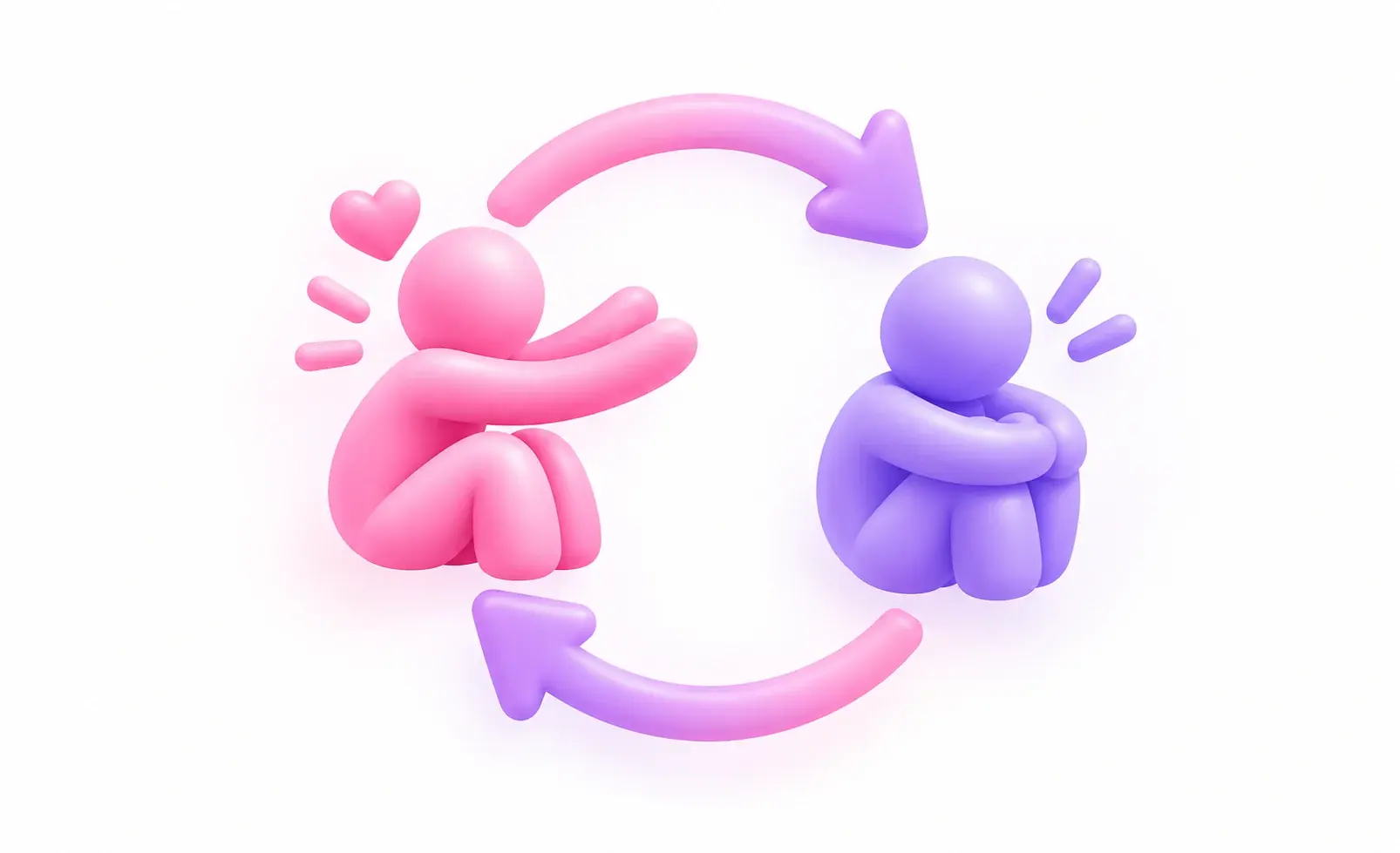
The most common relationship pattern tied to attachment is the pursuer-withdrawer loop: an anxious partner reaches for reassurance, an avoidant partner needs space to settle, and each person's coping move triggers the other's fear. Neither is wrong. They are reading the same moment of distance through different nervous systems.
Two things matter for a couple. First, attachment style is not a life sentence: research on "earned security" shows people shift toward secure when they are in a steady, responsive relationship, which is the whole point of working on it together. Second, clinical labels like "anxious" or "avoidant" are useful for understanding and terrible for arguing.
Why we skip the labels
"Telling your partner 'you're so avoidant' is a judgment, not an observation."
That is why 4couple scores the attachment layer underneath and never shows anyone a clinical label. You see a friendly Connection Type instead, which brings us to layer three.
Layer 3: what is a closeness type?
A closeness type describes how a person actually behaves when the relationship is under a little stress: when the partner is absent or quiet, when an argument starts, and when a feeling needs to come out. It is the practical, day-to-day face of attachment, read on three axes. 4couple measures these three axes with a short quiz and combines them into one of eight Connection Types.
Closeness
S
Secure
K
Seeking
When your partner needs time to themselves, are you comfortable, or do you start to feel disconnected? Secure partners can let a gap sit. Seeking partners feel the gap quickly and want to close it. Neither is better; seeking partners are often the ones who keep a couple warm.
Conflict
R
Reacher
W
Retreater
When an argument starts, do you want to talk it out right now, or do you need to step away before you can talk properly? Reachers resolve by engaging. Retreaters resolve by cooling down first. This single axis explains most "we always have the same fight" patterns.
Expression
O
Open
G
Guarded
Do you figure out your emotions by talking, or do you need time alone before you can say what is really going on? Open partners think out loud. Guarded partners need a while before they can open up, and often a gentle invitation.
Put a letter on each axis and you get a three-letter code. The eight combinations are the eight Connection Types, and together with your love language they make up your Relationship Profile, for you and for the partner you are paired with.
S-R-O
The Open Heart
Secure, reaches in conflict, talks things out
K-W-G
The Quiet Devotee
Seeks closeness, withdraws, keeps feelings in
Take the test: find your Connection Type in six statements
These are the six couples questions from the Connection Type quiz inside 4couple, in the same order. There are no right answers; every style is a real way to love.
Rate each statement
- +2Agree
- +1Slightly agree
- 0Neutral
- −1Slightly disagree
- −2Disagree
- 1
- 2
- 3
- 4
- 5
- 6
0 of 6 answered. Rate all six and your Connection Type shows up here.
Scoring by hand
Closeness
Statement 1 − 4
+ → S (Secure)
− → K (Seeking)
Conflict
Statement 2 − 5
+ → R (Reacher)
− → W (Retreater)
Expression
Statement 3 − 6
+ → O (Open)
− → G (Guarded)
Each axis runs from −4 to +4. A score of −1, 0 or +1 means you are balanced on that axis: read both neighbouring types and pick the one that fits.
The 8 Connection Types
Connection Type · 01
The Open Heart
Comfortable in love and shows it. Moves toward you and says it plainly; doesn't spiral when you need space.
S
Secure
R
Reacher
O
Open

Superpower
Makes hard conversations feel safe.

Watch-out
"Let's talk now" can overwhelm a partner who needs to cool down first.

Needs most
A partner who matches the honesty and doesn't go silent.
Connection Type · 02
The Quiet Resolver
Steady and wants things sorted, but keeps the inner world close. Fixes the problem before revealing the feeling under it.
S
Secure
R
Reacher
G
Guarded
Superpower
Calm under conflict; doesn't run from it.
Watch-out
Solving without sharing the feeling leaves a partner guessing.
Needs most
A partner who gently asks what's underneath, without pushing.
Connection Type · 03
The Steady Anchor
Secure and warm, but needs a beat to process before talking. Comes back to say exactly how they feel.
S
Secure
W
Retreater
O
Open
Superpower
Rarely reacts in the heat; brings calm.
Watch-out
The pause can read as distance to someone who wants to talk now.
Needs most
A partner who trusts that "give me a minute" isn't rejection.
Connection Type · 04
The Still Water
Independent and self-contained. Secure, processes privately, doesn't need to talk everything out.
S
Secure
W
Retreater
G
Guarded
Superpower
Unshakeable; adds no drama.
Watch-out
The quiet can be misread as not caring.
Needs most
A partner who reads actions as love, plus gentle invitations to open up.
Connection Type · 05
The Wholehearted
Loves all-in. Reaches for closeness, says what they feel, wants to feel chosen.
K
Seeking
R
Reacher
O
Open
Superpower
Nobody doubts how much they care.
Watch-out
Reaching hard for reassurance can tip into pressure when a partner needs room.
Needs most
Steady, frequent reassurance and a partner who doesn't withdraw.
Connection Type · 06
The Tender Pursuer
Craves closeness and chases it, but finds it hard to name what's wrong. "I'm fine" while clearly not fine.
K
Seeking
R
Reacher
G
Guarded
Superpower
Deeply devoted; never gives up on connection.
Watch-out
Pursuing without saying the real need makes a partner solve the wrong problem.
Needs most
A patient partner who helps put the feeling into words.
Connection Type · 07
The Sensitive Soul
Feels deeply and needs reassurance, but pulls back first when hurt, then opens up fully once safe.
K
Seeking
W
Retreater
O
Open
Superpower
Emotionally honest once they feel safe.
Watch-out
The pull-back reads as rejection when it's really a bid for reassurance.
Needs most
A partner who follows gently after the retreat.
Connection Type · 08
The Quiet Devotee
Loves deeply but it's hard to show under stress. Goes inward exactly when they most want reassurance.
K
Seeking
W
Retreater
G
Guarded
Superpower
Loyal and deep; love runs quiet but strong.
Watch-out
Going silent when closeness is most needed pulls the couple apart.
Needs most
A partner who reaches in gently and doesn't take the silence personally.
Six couples questions is deliberately light; it gets most people to the right neighbourhood in under a minute. Inside the app there is an optional deeper read (around 20 statements) that sharpens the type and shows how strongly you lean on each axis, the way personality tests show percentages.
The Connection Type is one layer. For a wider check-in, from affection to how you talk about hard things, take the relationship quiz: eight questions, about two minutes.
Your Relationship Profile inside 4couple
4couple is an AI relationship app for couples that builds a Relationship Profile from your love language and your Connection Type, then uses it in every conversation the app has with the couple, once you are paired. Here is where each layer is captured and what it changes.
Love language
Picked in the first two minutes
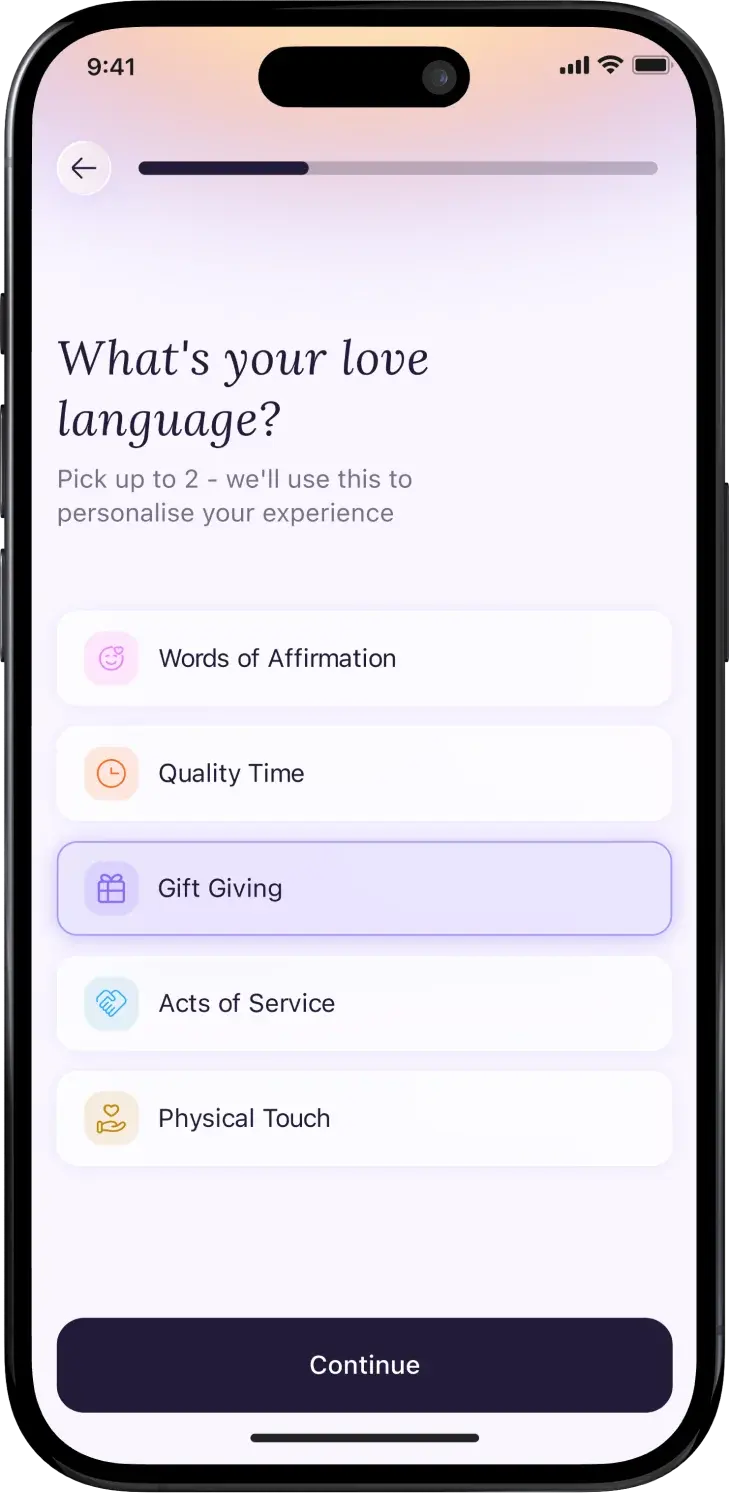
During onboarding each partner picks their love language and gets a one-line insight straight away. When your partner joins with your pairing code, the shared reveal shows the love-language dynamic between you: the same language, or two different ones, and what that means for a typical week.
From that moment the AI Companion coaches you in your partner's language, not yours. If your partner's language is acts of service and you are drafting an apology full of words, it will suggest adding the one thing you could do.
Connection Type
The six-statement quiz in the AI Companion
The couples quiz you just took sits at the entrance to the AI Companion. One statement per screen, warm language, under a minute. The reveal shows your type name, a short read, your superpower, your watch-out and what you need most. That is all you ever see.
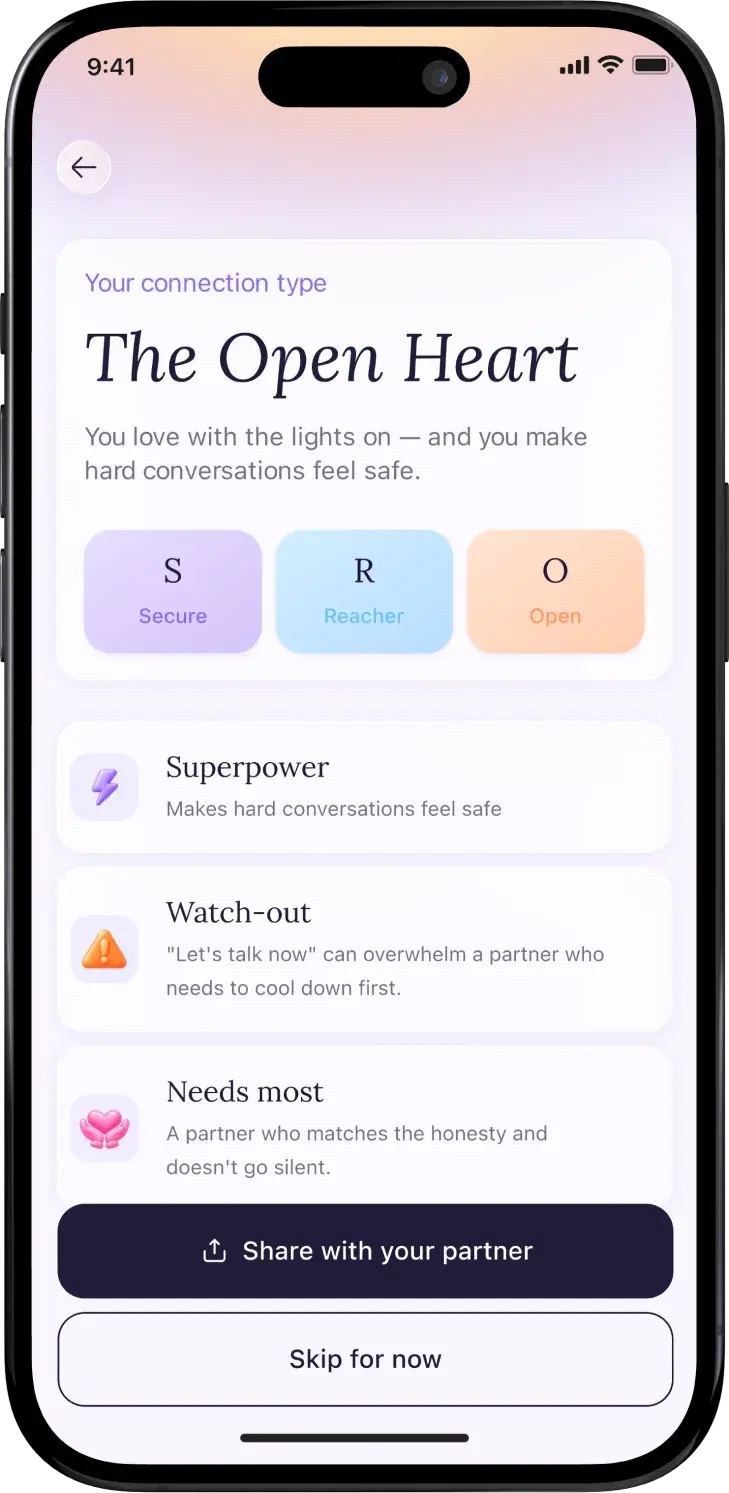
Underneath, the app stores your three axis scores privately and the Companion uses them as a soft prior for how it talks to you: whether to push a little or give space, how fast to move toward the hard part, how to de-escalate when you are flooded. It is a starting guess, not a verdict, and it updates as it gets to know you.
Partner combo
The reason to pair
Your type is interesting. The couple combination is the point. Once both paired partners have finished the quiz, 4couple shows the couple pairing: your two types side by side, how your axes meet, and the one move that helps most.
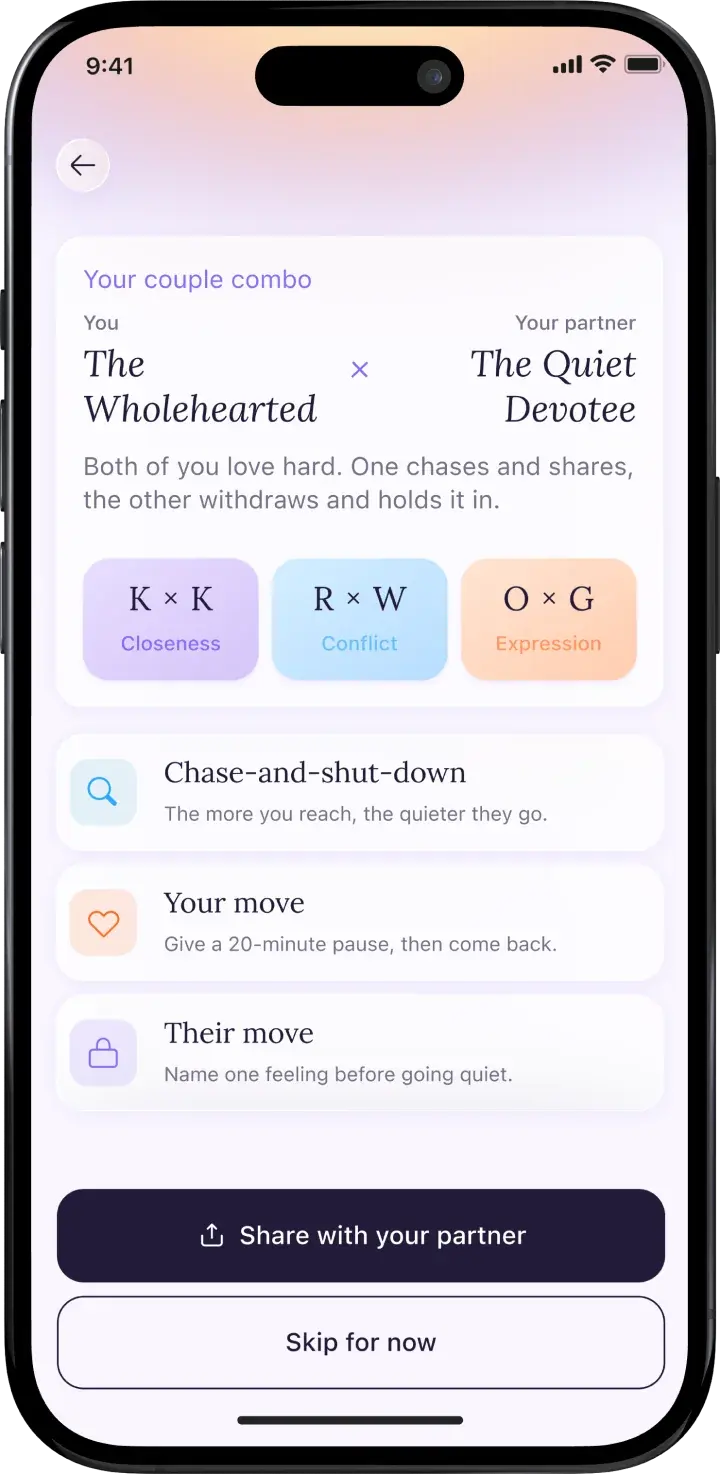
A Wholehearted paired with a Quiet Devotee gets the chase-and-shut-down pattern named for them, with a concrete fix, before they have had the fight again. Couples share this screen; it is the most sent card in the app.
Where the profile does its work

Translate My Emotions
When you type a raw message to your partner, the Companion already knows that you are, say, a Tender Pursuer writing to a Steady Anchor. It will help you name the real need (you tend to leave it out) and phrase the request in a way that respects their need for a beat. The output is in your voice, in their language.

Partner Chat
In a shared conversation between the paired couple, the app uses both profiles to time its help. If a Retreater goes quiet, the Reacher sees "your partner is working on their reply" instead of silence. If a Reacher's message is landing hot, the Retreater gets a "Discuss this message" door before they answer.

Daily mood check-in
Your Connection Type shapes the nudges. A Sensitive Soul who logs a low day gets a gentle suggestion to send a signal before withdrawing; a Still Water gets a prompt to say one sentence out loud.

Relationship tracker
Over weeks the dashboard shows mood trends for both partners next to the profile, so the couple can see when a hard stretch lines up with the pattern their types predict, and do the move early.
What we deliberately do not do

We never show clinical labels. Nobody in 4couple is told they are "anxious" or "avoidant"; the psychology is scored underneath and the surface stays human.
We never share one partner's private conversations with the other; the profile informs the AI, not the partner.
The type is never used to excuse behaviour: "I'm a Retreater" is a reason to say "give me 20 minutes and I'll come back," not a reason to disappear.
When two profiles meet: the couple combinations
The dynamics of a couple come from how the axes meet, so read your pairing axis by axis. Each combination has one move that does most of the work.
Closeness axis
Secure & Seeking
A stabilising match: the Secure partner is the calm base, the Seeking partner brings warmth and effort.
The one move
The Secure partner reassures proactively instead of assuming it is understood.
Seeking & Seeking
Two big hearts, but reassurance runs low when both need it at once.
The one move
Small daily rituals of reassurance (a signal, a message, a touch).
Secure & Secure
Stable and low-drama; risk is autopilot.
The one move
Keep investing on purpose: a planned date, a question of the day.
Conflict axis
Reacher & Retreater
The classic chase-and-pull-away loop; each move makes the other dig in.
The one move
A pause with a promise: "20 minutes, then we come back to it."
Reacher & Reacher
Both engage, which is good, but it escalates fast.
The one move
A shared signal to slow down.
Retreater & Retreater
Both avoid the hard talk, so issues drift unspoken.
The one move
Schedule the conversation so neither has to start it cold.
Expression axis
Open & Guarded
A pace mismatch: one shares freely, one needs time and privacy.
The one move
Open partner stops reading silence as a wall; Guarded partner offers small windows.
Open & Open
Great communication; watch for over-processing everything.
The one move
Agree what is small enough to let go.
Guarded & Guarded
Calm, but can drift into unspoken distance.
The one move
Short intentional check-ins.
Three full-type pairings that
come up a lot
The Wholehearted
×
The Quiet Devotee
Both love hard, but one chases and shares while the other withdraws and holds it in. High passion, high risk of the chase-and-shut-down spiral.
The move
The Devotee names one feeling before going quiet; the Wholehearted gives a 20-minute pause.
The Open Heart
×
The Steady Anchor
Both secure and open, just different pacing. An easy, healthy match.
The move
Respect the Anchor's need for a beat before the conversation.
The Still Water
×
The Sensitive Soul
Both retreat, but the Soul needs the reassurance the Water does not think to offer.
The move
The Water reaches in after a retreat, every time, even with one line.
Add love languages on top and the picture gets specific. A Quiet Devotee whose language is acts of service and a Wholehearted whose language is words of affirmation can both be giving everything and both feel unloved: one is cooking dinners, the other is waiting to hear a sentence. That is the fight from the top of this post, and it has three causes, not one.
How to use your Relationship Profile in daily life
A Relationship Profile is only useful if it changes a Tuesday evening for the couple. Three habits do that.
Swap profiles, not accusations

The first couple conversation to have is the one where each paired partner reads the other's type out loud and says which line is true and which is not. "Pursuing without saying the real need" lands very differently when the Tender Pursuer reads it about themselves than when their partner says it mid-argument. Do this on a calm evening, not after a fight.
One sentence per type
Each Connection Type has a sentence that its partner needs to hear in a tense moment. Learn yours.
If you are The Open Heart
"I want to talk, and I can wait if you need a minute."
If you are The Quiet Resolver
"I'm fixing it, and the feeling underneath is ___."
If you are The Steady Anchor
"Give me a minute. I'm not going anywhere."
If you are The Still Water
"I'm quiet, not upset with you. Here's one thing I feel."
If you are The Wholehearted
"I'm reaching because I'm scared, not to pressure you. Take your time."
If you are The Tender Pursuer
"I'm not fine. What I actually need is ___."
If you are The Sensitive Soul
"I need to step back for a bit, and I'd like you to come find me after."
If you are The Quiet Devotee
"I'm going quiet because this matters. Please don't read it as distance."
Speak their love language in their closeness type
The two layers combine. Reassuring a Seeking partner whose language is physical touch is a hand on the back, not a paragraph. Giving a Retreater whose language is quality time their 20-minute pause means planning something together for afterwards, so the pause has an end. Ask your partner directly, and write the answer down:
Ask your partner
"When you're upset, what do you want from me first: words, time, space or touch?"
In 4couple that answer is already in your paired profile, and the AI Companion reminds you of it when you are about to forget.
Good questions
Frequently asked questions
What is a Relationship Profile?
A Relationship Profile is the combination of three layers that describe how a person loves: their love language (how they give and receive love), their attachment style (how safe they feel in closeness) and their closeness type (how they behave when the relationship is under stress). 4couple builds one for each partner and compares them as a couple.
What is the difference between love languages and attachment styles?
Love languages describe how you prefer to receive love day to day: words, time, acts of service, gifts or touch. Attachment styles describe how you respond to closeness and distance: secure, anxious, avoidant or disorganized. A couple can share a love language and still clash on attachment, or the other way round.
What is a Connection Type?
A Connection Type is 4couple's friendly name for a closeness profile. It combines three axes, Closeness (Secure or Seeking), Conflict (Reacher or Retreater) and Expression (Open or Guarded), into one of eight types: The Open Heart, The Quiet Resolver, The Steady Anchor, The Still Water, The Wholehearted, The Tender Pursuer, The Sensitive Soul and The Quiet Devotee.
Is the Connection Type quiz an attachment style quiz?
It is related. The Closeness axis is scored on the same ideas as attachment research, but 4couple never shows clinical labels like anxious or avoidant. You get a warm type name, a superpower, a watch-out and what you need most.
Can my attachment style change?
Yes. Attachment research describes "earned security": people in a steady, responsive relationship tend to move toward secure over time. Retaking the quiz after a few months is normal and the app simply updates your type.
What if my partner and I have different love languages?
That is the most common situation for a paired couple. The fix is to give love in your partner's language, not yours, and to tell them plainly which language you hear best. 4couple shows both languages side by side after pairing and coaches each partner in the other's language.
Which couple combinations are hardest?
The Reacher x Retreater conflict pairing causes the most repeated fights, because one partner needs to resolve now and the other needs space first. The move that helps most is a pause with a promise: a fixed break with an agreed time to come back.
Can we take the quiz as a couple?
Yes. Each paired partner answers the six couples questions separately in the app; once both are done, 4couple shows the couple combination side by side. Couples who are not paired yet can take it here and compare results by hand. Want to see how connected you are overall? Try the free relationship quiz too.
Is this a replacement for professional help?
No. The Relationship Profile is a communication tool for everyday life, not a clinical assessment. If your relationship feels unsafe, please contact a qualified professional or a local support line.
Sources & further reading
- Chapman, G. The 5 Love Languages (1992).
- Bowlby, J. Attachment theory; Ainsworth, M. infant attachment studies (1960s–70s).
- Hazan, C. & Shaver, P. Romantic love conceptualized as an attachment process (1987).
The Relationship Profile is a communication tool for everyday life, not a clinical assessment. If your relationship feels unsafe, please contact a qualified professional or a local support line.